---
title: "What is AgentOps? The emerging discipline for AI agent operations"
date: 2026-04-15
updated: 2026-04-16
author: david
excerpt: "DevOps governs code. MLOps governs models. AgentOps governs actions: the autonomous decisions and tool invocations AI agents execute without waiting for human approval."
category: governance
tags: [agentops, governance, devops, mlops, observability, enterprise, agent-lifecycle]
draft: false
tldr: "AgentOps is the operational discipline for making autonomous AI agents observable, governable and accountable in production. It goes beyond DevOps (code deployment), MLOps (model lifecycle) and LLMOps (prompt performance) to address the unique risks of systems that take autonomous actions. The complete AgentOps stack has eight layers: agent registry, identity and access, runtime observability, policy enforcement, [risk classification](/research/blog/ai-agent-risk-classification), continuous certification, compliance mapping and cost/performance tracking."
seo:
title: "What is AgentOps? The emerging discipline for AI agent operations | Roval"
description: "AgentOps is the discipline of making AI agents observable, governable and accountable in production. Learn the eight-layer stack and how it differs from DevOps and MLOps."
faqs:
- question: "What does AgentOps do?"
answer: "AgentOps is the operational discipline that makes AI agents observable, governable and accountable in production. It covers the full lifecycle: discovery, classification, policy enforcement, runtime monitoring, continuous certification, compliance mapping and retirement. Think of it as what DevOps did for software delivery and MLOps did for model management, but for autonomous AI agents."
- question: "What is the difference between DevOps and AgentOps?"
answer: "DevOps governs deterministic code deployment: the same code produces the same behavior every time. AgentOps governs autonomous agents whose behavior is non-deterministic, context-dependent and potentially unpredictable. DevOps asks 'is the service running?' AgentOps asks 'is the agent acting within its approved boundaries?'"
- question: "What is the difference between LLMOps and AgentOps?"
answer: "LLMOps manages the performance of language models: prompt quality, hallucination rates, token costs, response relevance. AgentOps manages what happens when those models are given the authority to act, to invoke tools, modify data and trigger workflows autonomously. The moment a model can take actions, operational risk increases sharply and LLMOps alone is no longer sufficient."
- question: "How is AgentOps different from agent monitoring?"
answer: "Agent monitoring is one layer of AgentOps: the observability layer that logs what agents do in real-time. AgentOps encompasses the full operational discipline: inventory, risk classification, identity management, policy enforcement, continuous certification, compliance mapping and lifecycle management. Monitoring tells you what happened. AgentOps ensures the right thing happens in the first place."
- question: "Do I need AgentOps if I only have a few agents?"
answer: "If those agents take autonomous actions, access sensitive data or operate in regulated domains, yes. The risk isn't proportional to the number of agents; it's proportional to what they can do. A single trading agent or clinical decision support agent carries more operational risk than a hundred knowledge-base Q&A bots."
- question: "Where does Roval fit in AgentOps?"
answer: "Roval is the enterprise system of record for AI agents. It implements all eight layers of the AgentOps stack, from agent registry and risk classification through continuous certification, runtime observability and compliance mapping. Think of it as what Vanta is to compliance or ServiceNow is to IT service management, but for your AI agent estate."
---
## The third evolution of operational discipline
Every era of enterprise technology has produced its own operational discipline. When software delivery became too complex for manual deployments, DevOps emerged. When machine learning models needed to survive in production, MLOps followed. Now, as AI agents move from demos to decision-making in enterprise workflows, the industry needs a third evolution.
That evolution is AgentOps.
AgentOps (short for agent operations) is the discipline of making autonomous AI agents observable, governable and accountable in production. It encompasses the practices, tools and organizational processes required to deploy, monitor, certify and retire AI agents across the enterprise lifecycle.
This is not a minor extension of what came before. DevOps governs code. MLOps governs models. AgentOps governs *actions*: the autonomous decisions, tool invocations and multi-step workflows that AI agents execute without waiting for human approval.
The distinction matters because the failure modes are fundamentally different. When code breaks, you get downtime. When a model drifts, you get inaccurate predictions. When an agent acts outside its boundaries, it can send unauthorized emails, execute financial transactions, exfiltrate data or cascade failures through a [multi-agent system](/research/blog/multi-agent-governance), all before anyone notices.
:::fact{title="The scale of ungoverned agents"}
According to Gravitee's State of AI Agent Security 2026 report, more than 3 million AI agents are operating within corporations, but only 47.1% are actively monitored. That leaves an estimated 1.5 million agents running without oversight. Gartner predicts that by 2030, 50% of AI agent deployment failures will be due to insufficient governance platform runtime enforcement.
:::
## Why agents break every existing operational model
To understand why AgentOps is necessary, you need to understand what makes agents different from traditional software, ML models and even large language models.
**DevOps manages deterministic systems.** You write code, test it, deploy it and it behaves the same way every time given the same inputs. The operational challenge is reliability and velocity: shipping fast without breaking things. The tools reflect this: CI/CD pipelines, infrastructure-as-code, uptime monitoring.
**MLOps manages probabilistic systems.** Models produce predictions that are statistically accurate but never certain. The operational challenge is drift: ensuring the model's performance in production matches what it achieved in training. The tools reflect this: model registries, experiment tracking, data lineage, automated retraining pipelines.
**LLMOps manages generative systems.** Large language models produce text and the operational challenge shifts to output quality: hallucination rates, prompt effectiveness, content safety and cost control. The tools reflect this: prompt versioning, RAG pipeline management, evaluation frameworks, token usage monitoring.
**AgentOps manages autonomous systems.** Agents don't just generate outputs. They take actions. They invoke tools, call APIs, query databases, send messages, modify files and interact with other agents. The operational challenge is *behavioral governance*: ensuring agents act within approved boundaries, with appropriate human oversight, across their entire lifecycle.
Researchers at CSIRO's Data61 published a foundational taxonomy of AgentOps in their paper [*AgentOps: Enabling Observability of LLM Agents*](https://arxiv.org/abs/2411.05285), identifying the core problem: "most existing DevOps tools for agents primarily focus on LLM-specific metrics and prompt management, with limited support for the observability of agent-specific artifacts such as goals, plans and tools." In other words, the existing operational stack was built for a different kind of system.
:::cite{name="Virginia Dignum" title="Professor of Responsible AI, Umea University; Wallenberg Scholar" avatar="/images/experts/virginia-dignum.jpg" linkedin="https://www.linkedin.com/in/vdignum/"}
Responsible governance is an enabler of sustainable innovation, driving public trust, business differentiation and long-term competitive advantage. Governance should be understood not as a barrier to innovation but as its enabler.
:::
Virginia Dignum, member of the UN High-Level Advisory Body on AI, made this case in her [AAMAS 2025 keynote on responsible AI and autonomous agents](https://www.ifaamas.org/Proceedings/aamas2025/pdfs/p1.pdf). AgentOps is the operational instantiation of that principle: the discipline that turns governance from a policy document into a running system.
The four properties that make agents different from every prior system:
1. **Autonomy.** Agents act without waiting for human review. A traditional LLM generates a response. An agent generates a response, calls an API, writes to a database and triggers a downstream workflow, all before a human knows it happened.
2. **Tool use.** Agents invoke APIs, query databases, browse the web, execute code and interact with other agents. The [OWASP Top 10 for Agentic Applications (2026)](https://genai.owasp.org/resource/owasp-top-10-for-agentic-applications-for-2026/) identifies tool misuse, goal hijacking and supply chain vulnerabilities as top-tier risks specific to agents.
3. **Decision chaining.** A single agent interaction can involve dozens of sequential decisions, each building on the last. When something goes wrong at step 14, tracing accountability requires observability that most organizations don't have.
4. **[Behavioral drift](/research/blog/agent-drift-continuous-compliance).** Model updates, data distribution shifts and evolving business contexts change agent behavior over time, even without anyone modifying the agent itself.
## The AgentOps stack: eight layers of operational governance
Existing definitions of AgentOps tend to focus narrowly on observability, logging what agents do. That's necessary but insufficient. A complete AgentOps practice requires eight operational layers, from foundational infrastructure to compliance reporting.
### Layer 1: Agent registry
Every agent in the enterprise gets a record: what it does, what framework it's built on, which model it uses, what data it accesses, who owns it and what state it's in. This is the CMDB for agents: the authoritative system of record that makes the agent estate visible. Without a registry, every subsequent layer is built on guesswork. (For a deep dive on why this matters, see our article [*Why AI agents need a CMDB*](/research/blog/why-ai-agents-need-a-cmdb).)
### Layer 2: Identity and access
Each agent needs a unique, verifiable identity with least-privilege access controls. This is the layer Okta has championed with their [identity-first agent lifecycle management framework](https://www.okta.com/identity-101/ai-agent-lifecycle-management/), where every agent is treated as a "first-class digital citizen with verifiable identity and accountability." Agent credentials must have defined lifespans and access must be revocable at any moment.
### Layer 3: Runtime observability
This is the layer most people think of when they hear "AgentOps": the real-time capture of what agents are doing. Action logs, decision traces, tool invocation records, inter-agent communications, error rates and latency metrics. The EU AI Act [Article 12](https://artificialintelligenceact.eu/article/12/) requires automatic recording of events for high-risk AI systems with sufficient detail to enable post-hoc assessment. Building observability in from the start is dramatically cheaper than retrofitting.
### Layer 4: Policy enforcement
Behavioral boundaries expressed as executable rules, not just documented guidelines. If an agent attempts an action outside its approved scope (accessing a restricted data source, invoking a blocked tool, exceeding a financial threshold) the enforcement layer blocks the action and escalates. This is the "[policy as code](/research/blog/policy-as-code-ai-agents)" layer. If your governance can't be expressed as code, it's aspirational, not operational.
### Layer 5: Risk classification
Not all agents carry the same risk. A knowledge-base Q&A agent touching only public data is fundamentally different from a trading agent executing financial transactions. [Risk classification across three dimensions](/research/blog/ai-agent-risk-classification) (data sensitivity, decision authority and blast radius) determines what level of governance each agent requires. This maps directly to the EU AI Act's risk classification tiers.
### Layer 6: Continuous certification
Point-in-time assessments don't work for systems whose behavior changes continuously. Continuous certification means automated re-assessment when configurations change, drift detection when behavior deviates from baselines and expiration-based certification that forces periodic re-review. Gartner predicts that by 2030, half of organizations will use autonomous AI agents to interpret governance policies into machine-verifiable contracts, automating compliance enforcement.
### Layer 7: Compliance mapping
Controls mapped to applicable regulatory frameworks (EU AI Act, NIST AI RMF, ISO/IEC 42001) with evidence generated automatically, not assembled manually before an audit. The European Insurance and Occupational Pensions Authority (EIOPA) published a [formal Opinion on AI Governance and Risk Management](https://www.eiopa.europa.eu/document/download/88342342-a17f-4f88-842f-bf62c93012d6_en) in August 2025, requiring risk-based and proportionate governance measures for autonomous systems in insurance, a signal that sector-specific regulators are layering agent governance requirements on top of the EU AI Act.
### Layer 8: Cost and performance
Token usage, API call costs, error rates, retry frequency, human escalation rates. These are the operational economics of your agent estate. Without this layer, you can't answer the question that every CFO will eventually ask: what are these agents costing us and what value are they delivering?
:::fact{title="The Nordic caution gap"}
Deloitte's 2026 report on AI ROI in the Nordics found that 58% of Nordic respondents already using agentic AI anticipate 3+ years for significant ROI, compared to just 37% in the rest of Europe. The report attributes this partly to an IT-centric approach where the AI agenda is driven by the CIO (32% in the Nordics vs 23% in the rest of Europe) rather than business leaders.
:::
## AgentOps vs DevOps vs MLOps vs LLMOps
The operational disciplines are distinct but complementary. Here's how they differ across the dimensions that matter most.
| Dimension | DevOps | MLOps | LLMOps | AgentOps |
|-----------|--------|-------|--------|----------|
| **What it governs** | Code deployment | Model lifecycle | Prompt + RAG performance | Autonomous agent actions |
| **Primary risk** | Downtime | Model drift | Hallucination, data leakage | Unauthorized execution, cascading failure |
| **Version control** | Git repos | Model + data lineage | Prompt + RAG versioning | Agent state, tools, decision traces |
| **Evaluation** | Unit/integration tests | Accuracy, precision, recall | Coherence, groundedness | Task success rate, reasoning trace quality |
| **Monitoring** | Uptime, latency, errors | Drift, SLA adherence | Token usage, prompt failure rate | Tool call outcomes, behavioral anomalies |
| **Human oversight** | Rare (CI/CD automated) | Rare (if model is trusted) | Feedback for ranking | Adaptive: autonomous to human-in-the-loop |
| **Compliance scope** | SOC 2 for infrastructure | Model cards, bias audits | Content safety policies | EU AI Act, NIST AI RMF, ISO 42001 |
| **Identity model** | Service accounts | N/A | API keys | Agent-as-identity with lifecycle |
| **Failure mode** | Service goes down | Predictions degrade | Output quality declines | Agent takes unauthorized action |
| **Retirement** | Decommission service | Archive model version | Deprecate prompt | Revoke credentials, notify dependents, archive audit trail |
The critical insight from this comparison: each discipline was built to address a specific type of operational risk. DevOps addresses deployment risk. MLOps addresses prediction risk. LLMOps addresses generation risk. AgentOps addresses *action risk*: the risk that an autonomous system does something it shouldn't, at a scale and speed that outpaces human review.
These disciplines are additive, not replacements. An enterprise running AI agents needs all four, with AgentOps as the governance layer that sits above the others.
OWASP Agentic AI Security Summit: the intersection of AgentOps, security and governance | YouTube
## When do you need AgentOps?
Not every organization needs a formal AgentOps practice today. Here's a decision framework.
**You need AgentOps now if:**
- Your agents take actions (not just generate text), executing API calls, modifying records, sending communications or triggering workflows
- Your agents access sensitive data: PII, financial records, health information or proprietary business data
- Your agents interact with other agents, creating multi-agent workflows where failure can cascade
- You have more than 10 agents across more than 2 frameworks: LangGraph, CrewAI, Copilot Studio, custom code
- A compliance officer or auditor has asked about your AI agents, in which case you needed AgentOps yesterday
**You can wait if:**
- Your only AI usage is single-turn LLM queries with no tool access
- All AI interactions are fully human-reviewed before any action is taken
- You have fewer than 5 agents, all within a single platform, all owned by a single team
For most enterprises, the trigger isn't a technology milestone. It's a governance event. The EU AI Act coming into effect. A board member asking how many agents are running. An auditor requesting an audit trail for agent decisions. A security incident involving an unsanctioned agent.
The [ENISA Advisory Group's 2025 opinion paper on cybersecurity for AI](https://www.enisa.europa.eu/sites/default/files/2025-07/AG%20opinion%20paper%20on%20AI.pdf) recommended that organizations adopt "Secure by Design, Secure by Default, Secure in Operations" principles for AI systems, including practical guides for securing AI, interoperable risk management toolboxes and AI cybersecurity baselines. This is the European regulatory direction: governance is not optional and the expectations are becoming concrete.
Friederike Schurer, former data governance lead at UNICEF, UN Global Pulse and the Ada Lovelace Institute, posed the question at the [CEPS IDEAS Lab in March 2026](https://aiworld.eu/story/ceps-ideas-lab-how-can-europe-prepare-for-the-autonomous-ai-agent-economy) that every enterprise AgentOps practice must ultimately answer: what does "meaningful accountability look like when autonomous systems make decisions across organisational and national boundaries?"
## The AgentOps tooling market
The AgentOps tooling market is fragmented and fast-moving. Most tools cover one or two layers of the stack. None cover all eight.
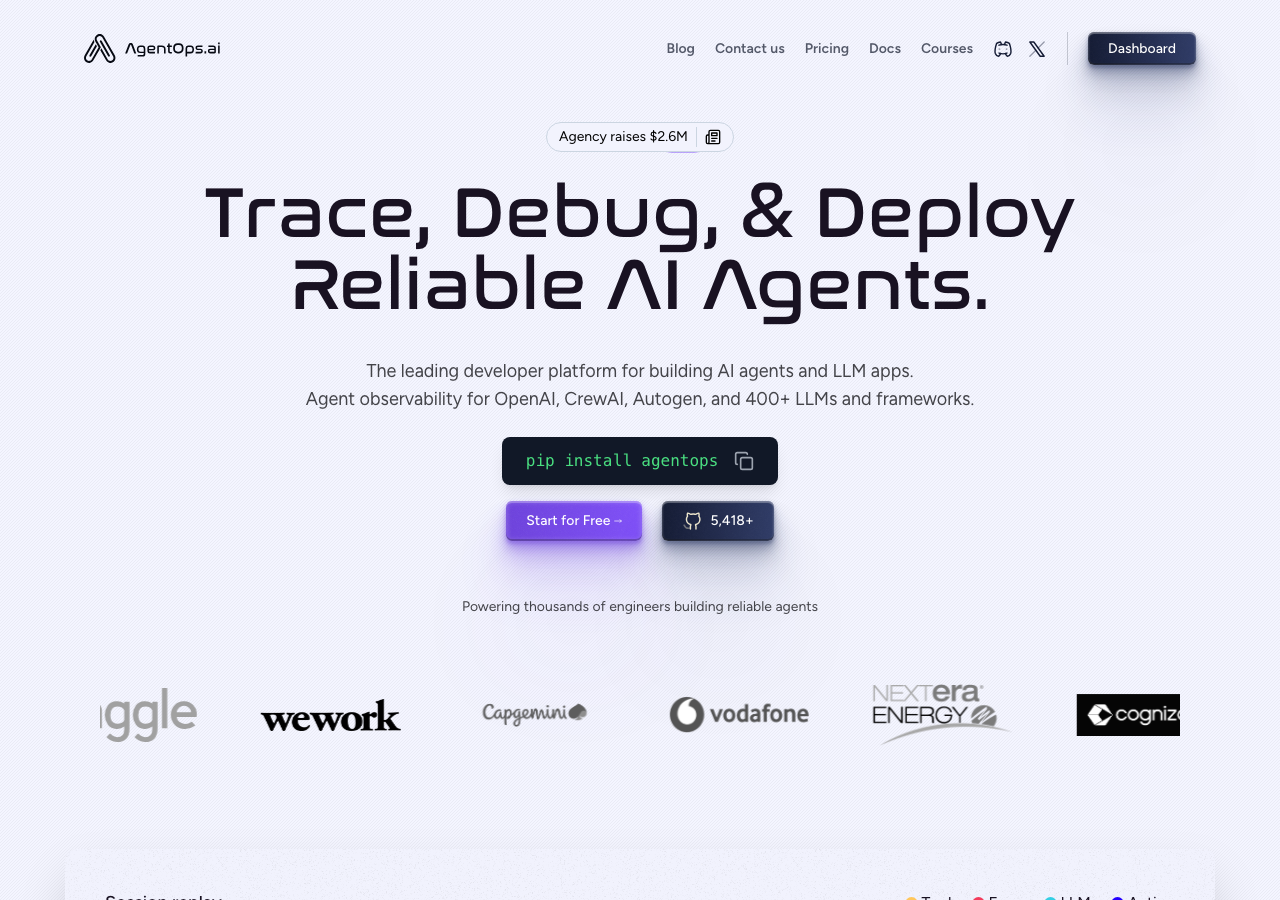
AgentOps.ai provides session replays, metrics and monitoring with just two lines of code | Source
**Developer-focused observability:** [AgentOps.ai](https://www.agentops.ai/) provides an open-source Python SDK for agent monitoring, supporting CrewAI, AutoGen and 400+ LLMs and frameworks. [LangSmith](https://smith.langchain.com/) offers tracing and evaluation for LangChain-based agents. [Arize Phoenix](https://phoenix.arize.com/) provides LLM observability with agent trace support. [Langfuse](https://langfuse.com/) offers open-source LLM engineering and agent analytics. These tools are strong on Layer 3 (runtime observability) but light on governance, compliance and lifecycle management.
**Platform-native tooling:** [Salesforce Agentforce](https://architect.salesforce.com/docs/architect/fundamentals/guide/agent-development-lifecycle) provides an Agent Development Lifecycle (ADLC) with unified tooling for design, development, testing, deployment and monitoring, but only for agents built within the Salesforce platform. [Google Cloud's AgentOps capabilities](https://www.youtube.com/watch?v=kJRgj58ujEk) bring observability to Vertex AI agents, again within the Google stack.
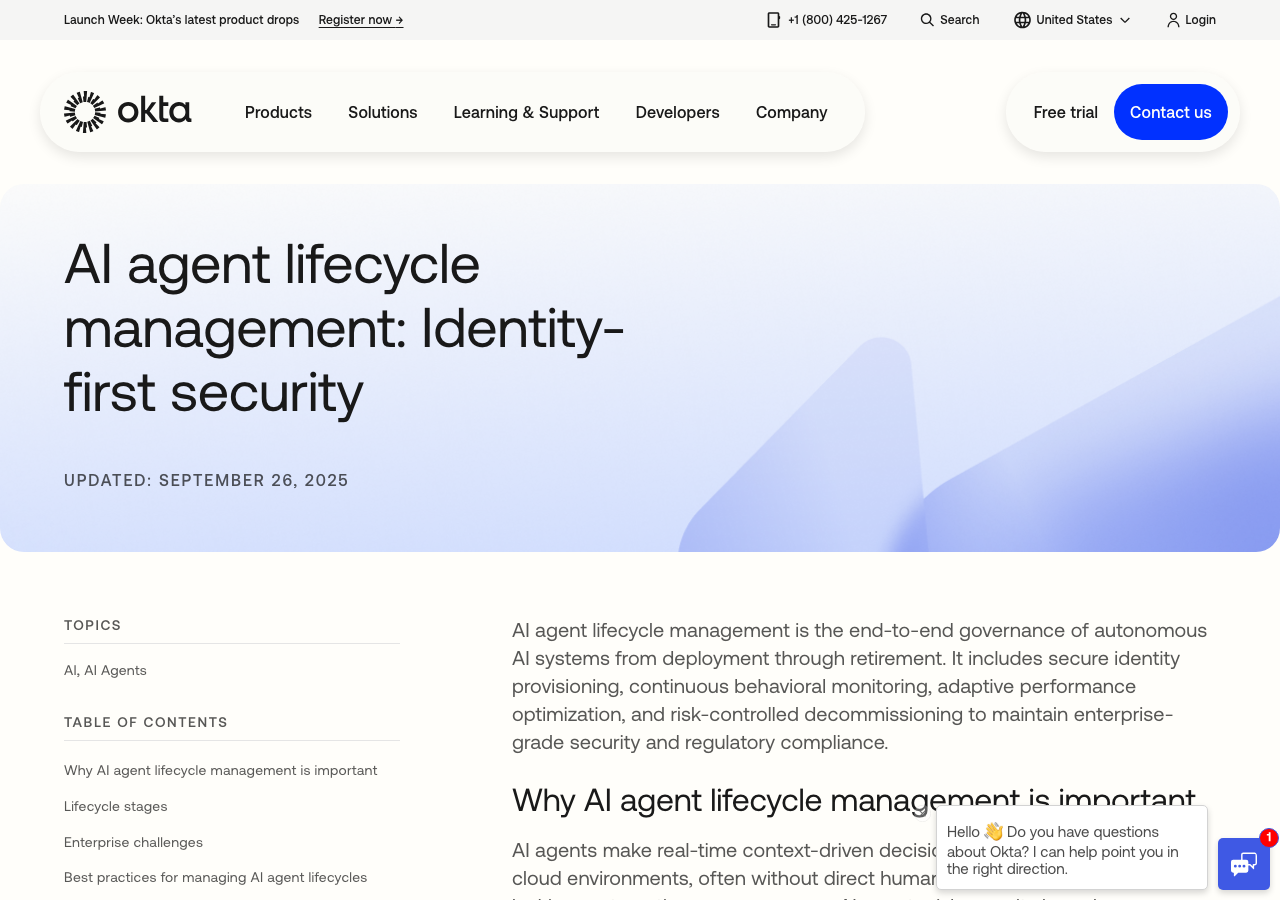
**Identity-first governance:** [Okta's agent lifecycle management](https://help.okta.com/oie/en-us/content/topics/ai-agents/ai-agents.htm) treats agents as non-human identities with discovery, provisioning, monitoring and decommissioning. Strong on Layer 2 (identity and access) with solid governance workflows, but scoped to identity rather than the full operational stack. According to Okta's "AI at Work 2025" survey, 91% of organizations are already using AI agents, yet only 10% have a well-developed strategy for managing these non-human identities.
Okta's identity-first approach treats every agent as a first-class digital citizen with verifiable identity | Source
**Enterprise governance platforms:** [Roval](https://roval.ai) provides the system of record for AI agents, covering the full eight-layer stack from agent registry and risk classification through continuous certification, runtime observability and compliance mapping. Framework-agnostic, designed for enterprises governing agents across multiple platforms and environments.
The market pattern is clear: developer tools solve for observability, platform vendors solve for their own stack, identity platforms solve for access control and governance platforms solve for the full lifecycle. Most enterprises will need a combination, with an enterprise governance layer providing the unified view across all of them.
:::cite{name="Clemens Wasner" title="CEO, enliteAI; Founder and Chair, AI Austria" avatar="/images/experts/clemens-wasner.jpg" linkedin="https://www.linkedin.com/in/clemenswasner/"}
The European challenge is precisely this translation layer: the distance between what builders deploy and what institutions can govern. We need operational disciplines that close the gap between regulation and reality.
:::
Clemens Wasner has spent nearly a decade bridging the gap between AI deployment and EU-level policy advocacy. At the [CEPS IDEAS Lab in March 2026](https://aiworld.eu/story/ceps-ideas-lab-how-can-europe-prepare-for-the-autonomous-ai-agent-economy), he argued that AgentOps is the operational discipline that closes that gap.
The market pattern is clear: developer tools solve for observability, platform vendors solve for their own stack, identity platforms solve for access control and governance platforms solve for the full lifecycle. Most enterprises will need a combination, with an enterprise governance layer providing the unified view across all of them.
:::fact{title="Most tools cover only 1-2 of the 8 layers"}
The AgentOps tooling market is fragmented. Developer tools like AgentOps.ai and LangSmith cover runtime observability. Platform vendors like Salesforce cover their own stack. Identity platforms like Okta cover access control. No single tool covers all eight layers of the AgentOps stack, which is why enterprises need a governance platform that provides the unified view.
:::
## Implementing AgentOps: where to start
If you're building an AgentOps practice from scratch, start at the bottom of the stack and work up.
**Week 1-2: Inventory.** Build the agent registry. Discover every agent running in the enterprise, sanctioned and unsanctioned. Assign owners. Record frameworks, models, data access and dependencies. This alone will surface surprises. (Our article on [agent sprawl](/research/blog/hidden-cost-ai-agent-sprawl) details why this step typically reveals 2-3x more agents than leadership expects.)
**Week 3-4: Classify.** Score every agent by risk tier. Map data sensitivity, decision authority and blast radius. Identify which agents are critical, which are high-risk and which are low-risk utilities that need light-touch governance.
**Week 5-8: Observe.** Deploy runtime monitoring for all critical and high-risk agents. Capture action logs, tool invocations and decision traces. Set up alerting for policy violations and behavioral anomalies.
**Week 9-12: Enforce and certify.** Define behavioral policies for each risk tier. Implement policy-as-code enforcement. Build continuous certification workflows that re-assess agents when configurations change or certifications expire.
**Ongoing: Map and report.** Connect your governance controls to applicable compliance frameworks. Generate audit evidence automatically. Publish internal "State of the Agent Estate" reports.
This phased approach mirrors the implementation roadmap in the [Roval AI Agent Governance Framework](/research/blog/ai-agent-governance-framework-8-pillars) and for good reason. You can't enforce policies for agents you haven't classified and you can't classify agents you haven't discovered.
## The discipline is emerging. The need is already here.
The term "AgentOps" is new. The need it addresses is not.
Every enterprise deploying AI agents is already facing the operational questions that AgentOps answers: how many agents do we have, what are they doing, who's accountable when they fail and can we prove compliance? The organizations that formalize these answers into an operational discipline (with tools, processes and ownership) will be the ones that scale their agent programs with confidence.
The alternative is what most enterprises have today: agents deployed by individual teams, tracked in spreadsheets, governed by hope. That works at 5 agents. It collapses at 50. And with Gartner forecasting 40% of enterprise applications embedding AI agents by end of 2026, 50 agents is six months away for most mid-to-large enterprises.
AgentOps is not a nice-to-have for 2028. It's the operational discipline your agent program needs today.
Roval implements all eight layers of the AgentOps stack in a single platform. The [agent registry](/platform/agent-registry) provides the system of record (Layer 1), identity and access controls are built into the [agent inventory](/solutions/agent-inventory) with least-privilege enforcement (Layer 2) and the Observer and [LLM monitor](/platform/llm-monitoring) deliver runtime observability (Layer 3).
Policy enforcement evaluates violations within seconds (Layer 4), [risk classification](/solutions/risk-classification) spans data sensitivity, decision authority and blast radius (Layer 5) and [compliance certification](/platform/compliance) ships with auto-expiry (Layer 6). Framework mapping for EU AI Act, SOC 2 and ISO 42001 (Layer 7) and full cost and performance tracking across the agent estate (Layer 8) round out the stack.
:::cta{title="See Roval in action" description="Book a 15-minute walkthrough of the agent registry, compliance certification and LLM monitoring." cta="Book a demo" href="/demo"}
:::
## Sources and further reading
| Source | URL |
|--------|-----|
| Dong, Lu & Zhu, "AgentOps: Enabling Observability of LLM Agents" (ArXiv) | https://arxiv.org/abs/2411.05285 |
| IBM, "What is AgentOps?" | https://www.ibm.com/think/topics/agentops |
| Gravitee, State of AI Agent Security 2026 | https://www.gravitee.io/state-of-ai-agent-security |
| Gartner, Top Predictions for Data and Analytics 2026 | https://www.gartner.com/en/newsroom/press-releases/2026-03-11-gartner-announces-top-predictions-for-data-and-analytics-in-2026 |
| OWASP Top 10 for Agentic Applications (2026) | https://genai.owasp.org/resource/owasp-top-10-for-agentic-applications-for-2026/ |
| Okta, AI Agent Lifecycle Management | https://www.okta.com/identity-101/ai-agent-lifecycle-management/ |
| Salesforce, The Agent Development Lifecycle | https://architect.salesforce.com/docs/architect/fundamentals/guide/agent-development-lifecycle |
| EU AI Act, Article 12 (Record-keeping) | https://artificialintelligenceact.eu/article/12/ |
| EIOPA, Opinion on AI Governance and Risk Management | https://www.eiopa.europa.eu/ |
| ENISA Advisory Group, Opinion Paper on Cybersecurity for AI (2025) | https://www.enisa.europa.eu/ |
| Deloitte, AI ROI in the Nordics (2026) | https://www.deloitte.com/no/no/issues/generative-ai/ai-roi-in-the-nordics.html |
| Virginia Dignum, AAMAS 2025 Keynote | https://www.ifaamas.org/Proceedings/aamas2025/pdfs/p1.pdf |
| CEPS IDEAS Lab, Autonomous AI Agent Economy (March 2026) | https://aiworld.eu/story/ceps-ideas-lab-how-can-europe-prepare-for-the-autonomous-ai-agent-economy |
| Covasant, MLOps/LLMOps/AgentOps Pipeline Guide | https://www.covasant.com/blogs/mlops-llmops-agentops-the-essential-ai-pipeline-guide |